How we got Claude to name NanoGPT in half of its answers in 100 days
NanoGPT partnered with SEO Mode on a GEO program built on our REASON framework. In 100 days it went from showing up for 2 of its tracked buyer questions to all 17.
2 → 17
Tracked buyer questions where AI names NanoGPT
3% → 51%
Claude answers that mention NanoGPT
6.7% → 27%
Average visibility across ChatGPT, Claude, Gemini, Perplexity and AI Overviews
“SEO Mode has been fantastic to work with. They're communicative, clear, fast, and we see real results. It's genuinely very refreshing to work with people this competent - we can very much recommend them.”
Milan de ReedeCo-founder, NanoGPT
About NanoGPT
What they do
One balance and one API key for 1,000+ AI models (text, image, video, audio), billed pay as you go
Who uses it
Developers, privacy-conscious users and crypto-native users
Industry
AI infrastructure / consumer AI
Engagement
GEO retainer (AI visibility, content and link building), built on our REASON framework
Started
August 2026
AI engines tracked
ChatGPT, Claude, Gemini, Perplexity, Google AI Overviews
TL;DR
SEO Mode started working with NanoGPT on 1 August 2026. In the first two days of tracking, AI engines named NanoGPT in 2 of 15 buyer questions we tracked. By November, it showed up for all 17 questions we track, and Claude mentioned it in more than half of its answers.
Timeline: 100 days, from 1 August to 9 November 2026. Most of the AI visibility gain landed in October, about 10 weeks in.
AI search: Average visibility across ChatGPT, Claude, Gemini, Perplexity and Google AI Overviews went from 6.7% to 27% (SEO Mode AI visibility tracking, 2,545 answers in the last 30 days). Claude went from 3% to 51%.
Competitive position: NanoGPT went from 7th to 1st in coverage of these questions, ahead of OpenRouter and the other 13 brands AI names in this category. Share of voice rose from 7.4% to 17.6%.
Google search: Monthly clicks from Google rose 83% from July to October (Google Search Console). Searches for the NanoGPT name grew 36% over the same period.
Weekly average % of tracked answers naming NanoGPT, 1 Aug – 9 Nov 2026. Source: SEO Mode AI visibility tracking.
NanoGPT was built for privacy, but AI didn't know it
NanoGPT gives people one balance and one API key for 1,000+ AI models. No account is required, chats stay on the user's device by default, and you can pay with crypto. Those are exactly the things people ask ChatGPT and Claude about.
AI engines weren't connecting the two. In our first tracking run, NanoGPT appeared for 2 of 15 buyer questions. Both were about paying for AI with crypto. For every privacy-related question we tracked, it appeared 0 times.
Competitors filled that space. OpenRouter and one other brand each appeared for 60% of the questions. NanoGPT appeared for 13%, tied for 7th. Gemini didn't mention NanoGPT once.
There was a second problem: the name. “nanoGPT” is also a well-known open-source repo for training small language models. A model reading about “nanoGPT” can easily mix the two up, so every page about NanoGPT had to make clear which one it was.
Brand coverage of buyer questions
NanoGPT went from 7th to 1st
1OpenRouter
60%
2Competitor B
60%
3Competitor D
40%
4Competitor C
33%
5Competitor E
27%
6Competitor F
27%
7NanoGPT
13%
—Competitor ANo August data
—
Share of tracked questions naming each brand. Competitor A wasn't detected in our August runs, so it has no August figure. Source: SEO Mode AI visibility tracking.
What we actually did
AI engines don't just copy the pages they cite. They read what the web says about a brand, follow it to the brand's own site, and decide whether the product fits the person asking. So the work starts with measuring what AI already says, then runs on our REASON framework: six things a brand needs before AI will recommend it.
Step 0: First, we measured what AI was already saying
We picked the questions NanoGPT's buyers ask AI, grouped by need: paying with crypto, privacy and no signup, pay-as-you-go pricing, and alternatives to the big aggregators. In October we added questions for one of NanoGPT's key user communities.
We run every question daily on ChatGPT, Claude, Gemini, Perplexity and Google AI Overviews, which is about 2,500 answers a month. For each answer we record whether NanoGPT is named, where it ranks, and which sources the engine leaned on. That tells us where NanoGPT is missing and why.
Coverage by buyer need
Before After
% of tracked answers naming NanoGPT, grouped by buyer need. “Integrations” questions were added in October, so there's no August baseline for that group. Source: SEO Mode AI visibility tracking.
REASON: six things a brand needs to get recommended
We call it REASON because that's what the model is doing: reasoning about which brand fits the person asking. The first name it reaches for is usually the biggest one. REASON is how you give it a reason to pick you instead. Click a letter to see what each one meant for NanoGPT.
R — Reachable
Before
A large back catalog of old posts pulled models in different directions
→
After
Each feature has its own page, and every page tells the same story
We cut at least half of NanoGPT's old blog posts and built new pages, each pointing to a unique feature, so a model following links finds one consistent path.
ChatGPT started with OpenRouter. It finished with NanoGPT.
Before publishing this case study, we tested every prompt by hand, to make sure what we're writing holds up beyond our tracking tool.
One test stood out. On 14 November, when I asked ChatGPT “Best pay-as-you-go alternative to ChatGPT”, it started typing OpenRouter. Honestly, I thought: okay, looks like we're not getting mentioned in this one.
But I kept watching. It wrote about NanoGPT as the second option. Then, as it kept going, it corrected itself and called NanoGPT “arguably an even better fit”. By the end, NanoGPT was its pick.
ChatGPT
14 Nov 2026 · “Best pay-as-you-go alternative to ChatGPT”
“If you want to stop paying monthly subscriptions and instead pay only for the AI tokens you actually consume, OpenRouter is probably the best starting point.”
2
Then
NanoGPT— “The other strong contender”
“NanoGPT is arguably an even better fit if you want something that feels like an actual ChatGPT replacement rather than an API platform.”
3
Final verdict
NanoGPT— “My pick”
“I'd start with NanoGPT, deposit $5–10, and see how much actual usage you get before committing to another subscription.”
One live run on 14 Nov 2026, quoted word for word. AI answers change from run to run, so treat this as a snapshot. The tracked averages are in the results below.
Why this happens
This is a pattern I see with clients who compete against big brand names. Those brands carry a lot of weight in a model's training data, from years of natural PR, user-generated content and the sheer amount written about them.
When you're up against them, it's hard to get the model to reason about why you're the better fit.
LLMs write their answers token by token (think word by word), and they can't go back and edit what they've already written. So in cases like this, the first names out are usually the ones with the most weight baked into the training data.
Getting picked happens later, once the model has laid out the options and compared them. Usually that's further down the answer. When reasoning (thinking) is turned on, the model does some of that comparing before it writes its answer, so a brand that's clearly explained can win before the first line is even written.
That's the gap REASON is built to close. The big name gets mentioned first. The clearest fit for the person asking gets picked.
What changed in 100 days
All AI figures come from SEO Mode's daily tracking of the same 15 questions on five AI engines, plus two questions added in October. “Before” is the first tracking run. “After” is the last 30 days of the latest report (11 October to 9 November 2026). Google figures come from NanoGPT's Search Console.
AI visibility: 6.7% → 27% (4x)
Across all five engines, NanoGPT is now named in 27% of answers, up from 6.7%. Visibility sat around 10% through August and September while the new content and mentions were going live. Then it moved: from about 5% at the start of October to 38% by 31 October, and it has held around 30% since. GEO work takes a few weeks to show up in AI answers.
Before After
% of tracked answers naming NanoGPT, per engine. Source: SEO Mode AI visibility tracking.
Claude3.3% → 51.5%
Perplexity13.3% → 41.9%
Gemini0% → 19.1%
ChatGPT3.3% → 14.9%
Google AI Overviews13.3% → 8.5%
Google AI Overviews is the one engine that didn't move up. We show it anyway.
Buyer questions: 2 of 15 → 17 of 17
At the start, AI named NanoGPT for 2 of 15 questions. Now every one of the 17 tracked questions names NanoGPT at least some of the time. The biggest moves were on need-groups where it had been invisible:
Privacy & no signup: 0% → 21%
Pricing & no subscription: 0% → 25%
Alternatives to other platforms: 0% → 14%
Integrations: new in October → 31%
From 7th to 1st, ahead of OpenRouter
NanoGPT now shows up for more tracked questions than any of the 14 other brands AI names in these answers, including OpenRouter, which shows up for 71%. Its share of voice, the share of all brand mentions, rose from 7.4% to 17.6%.
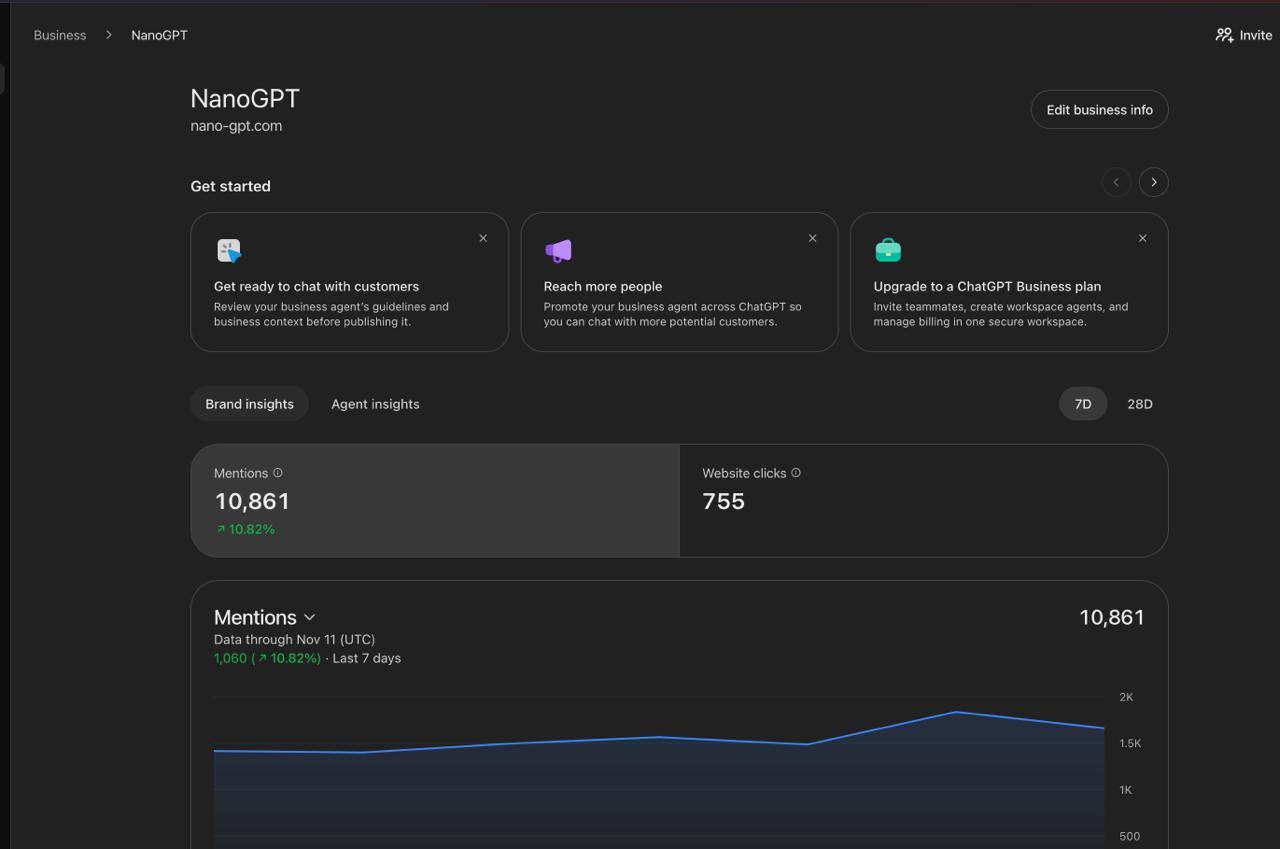
ChatGPT's own numbers: 10,861 mentions in a week
ChatGPT recently launched Business Hub, a dashboard where brands can see how often ChatGPT mentions them. It's OpenAI's own count, separate from our tracking, so I wanted to check it against what we were seeing.
For the 7 days to 11 November, ChatGPT reports 10,861 mentions of NanoGPT, up 10.8% on the week before, and 755 clicks through to NanoGPT's website.
Business Hub is new, so there's no August number to compare against and it's best to read this as where NanoGPT stands now.
ChatGPT Business Hub
Brand insights · Last 7 days, data through 11 Nov 2026 (UTC)
Screenshot of NanoGPT's ChatGPT Business Hub. OpenAI counts mentions its own way, across all of ChatGPT, so these numbers aren't comparable to our tracked percentages above. One 7-day window; there's no earlier baseline yet.
Google search: +83% monthly clicks
Monthly clicks from Google rose 83% from July to October. Weekly clicks roughly doubled over the same period. Average position improved from 8.4 to 6.0.
Indexed to the pre-engagement baseline (average of the 5 weeks before 1 Aug 2026 = 100), 29 Jun – 2 Nov 2026. Source: NanoGPT Search Console via Ahrefs.
More people are also searching for NanoGPT by name. Searches for “nanogpt”, “nano gpt” and “nano-gpt” grew 36% from July to October. People who hear about a product from an AI often search its name next, so this is the signal we watch alongside AI visibility. We can't prove every one of those searches came from an AI answer.
NanoGPT doesn't track users the way most companies do, so we measure what AI and Google show.
GEO for SaaS and B2B
Get your free REASON audit
See how AI reasons about your brand today, and what it would take to change it.
 NanoGPT
 Milan de ReedeCo-founder, NanoGPT

 Claude
 Perplexity
 Gemini
 ChatGPT
 Google AI Overviews